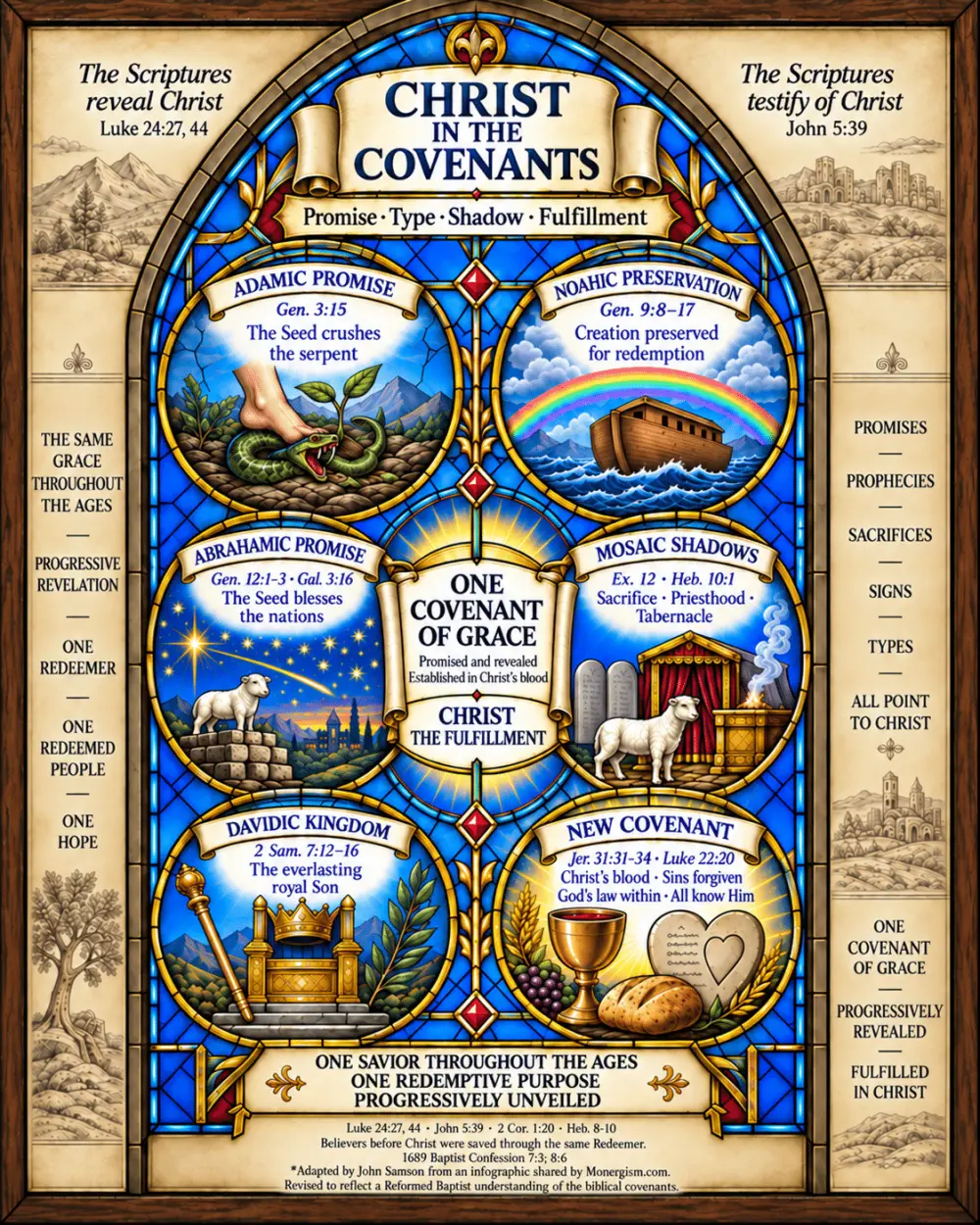
Christ in the Covenants: A Guide to the Window
Have you ever stood in front of an old church window and wondered what all the pictures meant? The people who made those windows were teaching. Many who sat beneath them could not read, so the glass did the preaching. The infographic below works the same way. Every panel, every scroll, every line down the sides is saying something. Let me walk you through it.
The title and the two corners
Across the top: "Christ in the Covenants." That is the claim of the whole window. The Bible is not a collection of disconnected stories with Jesus tacked on at the end. He is the subject from the first page. The two corner texts make the point from His own lips. On the Emmaus road, "beginning with Moses and all the Prophets, he interpreted to them in all the Scriptures the things concerning himself" (Luke 24:27). And to the religious leaders of His day: "You search the Scriptures because you think that in them you have eternal life; and it is they that bear witness about me" (John 5:39). Underneath the title sit four words: Promise, Type, Shadow, Fulfillment. Promises, types, and shadows all point forward. Fulfillment is where they arrive. Keep those words in mind as you look at the six circles.
The six circles
Adamic Promise (Genesis 3:15). The very first gospel sermon was preached by God Himself, in a garden, to a serpent. Speaking of the offspring of the woman, He said, "he shall bruise your head, and you shall bruise his heel." It was a word of judgment on the serpent, and buried inside it was hope for the two guilty people standing nearby. A heel comes down on a serpent's head. That is the picture in the glass. The Seed crushes the serpent. Everything that follows in the Bible is the outworking of that one promise. Behind this first panel stands the covenant of works, which Adam broke as the head of the whole human race. The promised Seed is the last Adam, who would keep it on behalf of His people and give them life (Romans 5:19; 1 Corinthians 15:45).
Noahic Preservation (Genesis 9:8-17). The rainbow over the ark is about preservation more than rescue. God promised never again to destroy the earth by flood, and in so doing He guaranteed that the stage would still be standing when the Savior stepped onto it. Creation preserved for redemption.
Abrahamic Promise (Genesis 12:1-3; Galatians 3:16). God told Abraham, "in you all the families of the earth shall be blessed." Paul tells us exactly who that blessing came through. The promise was made "to your offspring," and Paul adds, "who is Christ." The animal on the altar under the stars recalls Mount Moriah, where a ram died in Isaac's place and Abraham named the spot "The LORD will provide" (Genesis 22:14). God Himself supplied the substitute. Jesus said of him, "Your father Abraham rejoiced that he would see my day. He saw it and was glad" (John 8:56).
Mosaic Shadows (Exodus 12; Hebrews 10:1). Tablets, tabernacle, lamb, altar. The law given through Moses was, in the words of Hebrews, "a shadow of the good things to come instead of the true form of these realities." A shadow is real, but it is not the thing itself. It is cast by the thing itself. Every Passover lamb, every priest, every curtain was the shape of Christ falling backward across the centuries.
Davidic Kingdom (2 Samuel 7:12-16). God promised David a son whose throne "shall be established forever." No son of David sat on a throne in Jerusalem after the exile, and yet the promise stood, because the Son it pointed to was not merely David's. He is David's Lord as well as David's son, and His kingdom has no end.
New Covenant (Jeremiah 31:31-34; Luke 22:20). Cup, bread, and a heart bearing God's law. Jeremiah promised a covenant unlike the one at Sinai: sins forgiven, God's law written on the heart, and this, "they shall all know me, from the least of them to the greatest." Every member of this covenant knows the Lord. That is why we baptize those who credibly profess faith in Christ, and not infants. At the Last Supper Jesus lifted the cup and said, "This cup that is poured out for you is the new covenant in my blood." What Jeremiah promised, Jesus poured out.
The scroll in the middle
"One Covenant of Grace. Promised and revealed. Established in Christ's blood. Christ the fulfillment." This is the center of the window and the center of the matter. These six panels are not six ways of being saved. They trace one plan, unveiled by stages. Before Christ came, the covenant of grace was promised and progressively revealed, and believers were already receiving its saving benefits through the Redeemer God had promised. In Christ's death the covenant of grace was established in history as the new covenant, sealed with His own blood. Paul puts it in one sentence: "all the promises of God find their Yes in him" (2 Corinthians 1:20).
The sidebars and the banner
Read the right side first. Promises, prophecies, sacrifices, signs, types: all point to Christ. That is the Old Testament in five words. Lower down the same side, the window sums itself up: one covenant of grace, progressively revealed, fulfilled in Christ. Now the left side. The same grace throughout the ages. Progressive revelation. One Redeemer. One redeemed people. One hope. God did not have a Plan A for Israel and a Plan B for the church. He has one people, gathered from every age, saved by one Savior. The banner across the bottom says it in three lines: one Savior throughout the ages, one redemptive purpose, progressively unveiled.
The line at the bottom
"Believers before Christ were saved through the same Redeemer." How could Abraham be saved by a Savior who had not yet been born? Our confession answers it carefully. Although the price of redemption was not actually paid by Christ until after His incarnation, "the virtue, efficacy, and benefit thereof were communicated to the elect in all ages" (1689 Confession 8.6). Hebrews says the same thing: Christ's death "redeems them from the transgressions committed under the first covenant" (Hebrews 9:15). Abraham looked forward. We look back. He saw it dimly; we see it plainly. But both of us are looking at the same cross.
So here is the question the window leaves you with. When you read your Old Testament, are you looking for Him? He is there. He said so Himself. We do not find Him by inventing hidden meanings; we find Him by following the connections Scripture itself gives us. May God give us eyes to see the Savior on every page, and hearts to worship Him when we do.
* * *